Stretch marks across the abdomen and a caesarean incision scar are different problems, so treating them starts with identifying exactly what you are looking at. You will be able to judge timing, likely benefit, risks for Indian skin tones, and the questions to ask before choosing laser treatment.
Key takeaways
- Stretch marks and caesarean scars require separate diagnosis and treatment plans.
- Wait until the incision is fully healed before considering laser treatment.
- Ask about pigmentation risk, sun protection and settings suited to Indian skin.
- Compare expected improvement with multiple sessions, downtime and total treatment cost.
Are stretch marks and a caesarean scar the same problem?
Stretch marks after a C-section and the surgical incision are different problems, so they need separate assessment. Striae distensae are elongated dermal marks caused by skin stretching and hormonal changes; a cesarean scar is a localised line where skin was cut and repaired.
Newer stretch marks usually appear red, pink or purple and run in parallel lines across the abdomen. Older striae become white or silver and may look indented. A healing incision instead follows the surgical line and may be pink, tight, tender or slightly raised.
Before considering laser treatment, check for these distinctions:
- A flat, mature scar is different from a hypertrophic scar, which remains within the incision, and a keloid, which grows beyond the original wound.
- Drainage, spreading redness, increasing pain, warmth or wound separation needs medical review, not cosmetic treatment.
- Darkening around either lesion can be post-inflammatory hyperpigmentation, not a stretch mark.
Abdominal striae and the caesarean scar may need different laser settings, treatment timing or non-laser options. A scar that is widening, painful, infected or actively becoming raised is not ready for routine laser resurfacing.
This is why cesarean scar and stretch mark treatment should begin with examination of each target rather than one combined procedure or a promise of complete removal.
When is laser treatment safe after a caesarean?
Laser treatment is safe only after the caesarean incision has completely healed, not after a preset number of postpartum weeks. The skin must be closed, dry, free from drainage, infection, open areas and significant inflammation, and a clinician must assess whether the scar has matured enough for treatment.
1. Arrange a postpartum examination before booking a laser session. The review should check wound complications, breastfeeding, current medicines, skin conditions and any history of hypertrophic scars or keloids. A rapidly thickening, painful or widening scar needs medical assessment, not cosmetic resurfacing.
2. Disclose breastfeeding before treatment. Breastfeeding does not automatically prohibit every skin laser, but the clinician must review topical anaesthetic, pain medicines and infection-prevention drugs, especially when treatment is near the breast or nipple. Do not stop breastfeeding without medication-specific advice.
3. Postpone treatment for fever, pus, worsening redness, an open wound, active rash or unexplained pain. These signs can indicate infection, delayed healing or another condition that laser could worsen.
Elective laser is generally deferred during pregnancy because its safety and benefit are not established well enough. Pregnancy stretch mark laser in Mumbai is therefore not decided by the city, calendar or delivery date alone; readiness depends on examination findings. Even after healing, abdominal striae and the caesarean scar may need separate treatment decisions.
What happens during treatment, and which marks respond best?
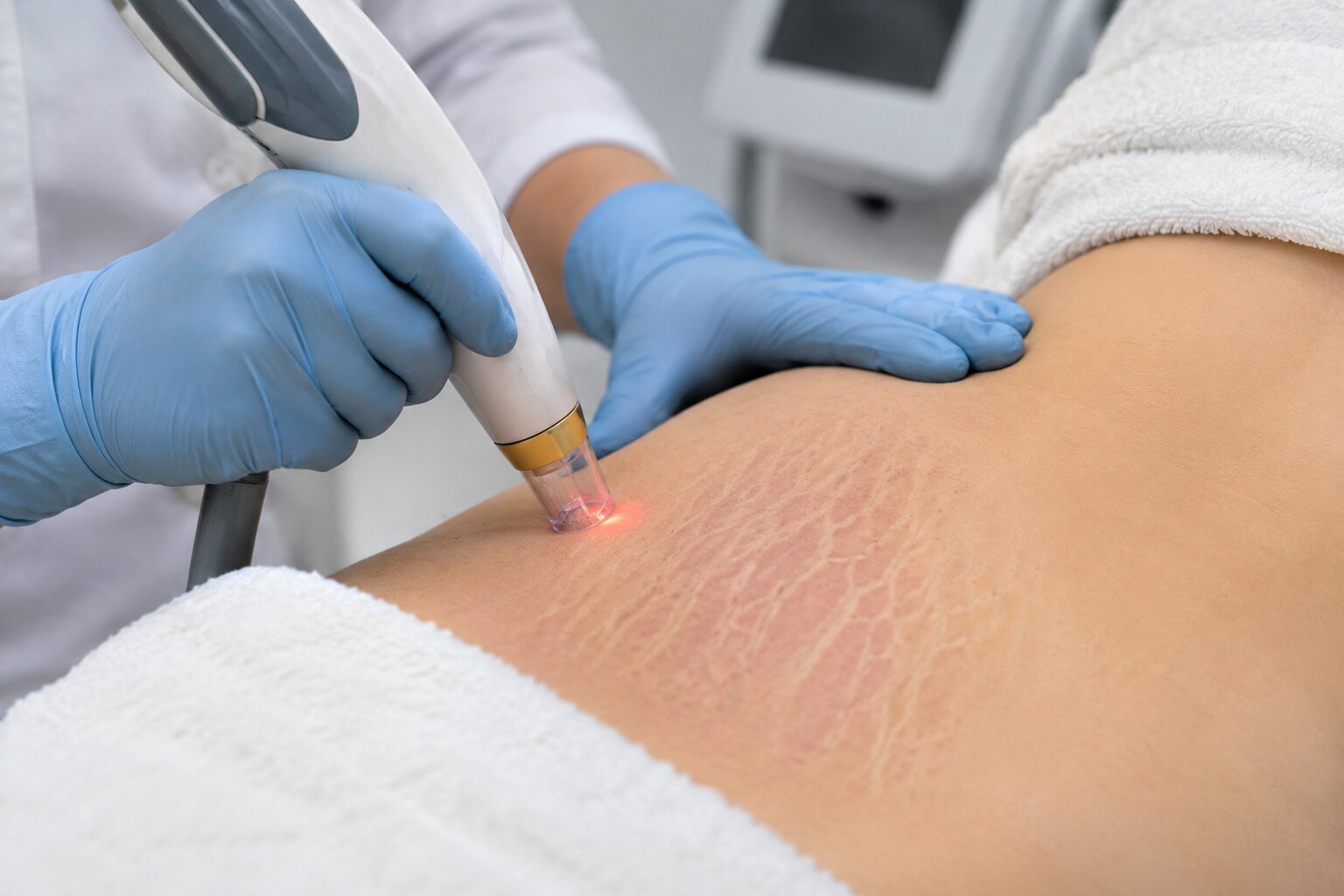
Expect a short, staged appointment rather than an instant removal procedure. The consultation should photograph and classify each target, review your skin type and medical history, and select an ablative fractional CO2 or Er:YAG device, or a fractional non-ablative 1540–1550 nm system. A test spot, skin preparation and strict sun protection may come first.
| Option | Typical trade-off | Best explained as |
|---|---|---|
| Ablative CO2 or Er:YAG | More visible healing and downtime | Stronger resurfacing for selected cases |
| Non-ablative 1540–1550 nm | Faster recovery, often subtler improvement | Gradual texture and colour change |
On treatment day, topical anaesthetic numbs the area before laser passes take minutes rather than hours. Cooling or prescribed aftercare follows. Heat or stinging, redness, swelling, pinpoint crusting and peeling are expected; visible healing lasts several days, with ablative treatment usually requiring more downtime.
Multiple sessions are commonly needed, spaced according to recovery and response. New red or purple striae are a more favourable target than deep white or silver marks, but neither disappears completely. The realistic result is lower contrast and smoother texture, not unmarked skin.
For anyone considering stretch mark laser treatment after cesarean in Mumbai, remember that the incision and surrounding striae may respond differently. A prominent caesarean scar can soften or look less irregular while the stretch marks remain visible.
What risks matter most for Indian skin tones?
The main trade-off is stronger resurfacing versus recovery. Fractional ablative CO2 and Er:YAG lasers may create more visible improvement, but they also cause more downtime and carry greater pigment risk. Fractional non-ablative systems, including 1540–1550 nm devices, usually heal faster but may improve stretch marks more modestly or slowly.
| Option | Main advantage | Main concern |
|---|---|---|
| Ablative CO2 or Er:YAG | Greater resurfacing effect | More heat, peeling, downtime and pigment change |
| Non-ablative fractional laser | Faster healing | Slower or less noticeable improvement |
Fitzpatrick IV to VI skin tones, common among Indian patients, need particular caution. Discuss pain, heat, swelling, peeling, infection, delayed healing, prolonged redness, burns, post-inflammatory hyperpigmentation, hypopigmentation and reactivation of pigmentation. Evidence remains promising rather than definitive: studies use different devices and scoring systems, so no laser is proven best for every patient.
- Ask for conservative settings, an appropriate test spot and an operator experienced with darker phototypes. Use strict sun protection before and after treatment; Mumbai’s sunlight can prolong or reactivate pigmentation.
- Treat the phrase monalisa touch for pregnancy marks as a warning sign. MonaLisa Touch refers to a fractional vaginal laser marketed for vaginal symptoms, not a validated treatment for abdominal striae or a C-section incision.
- Do not treat vaginal-laser marketing as abdominal evidence. The FDA criticised unproven vaginal rejuvenation claims, with reported burns, scarring, pain and painful intercourse.
How can you decide whether treatment is worth the cost and downtime?
The cost is easier to justify when the marks or mature scar cause persistent distress, the wound is fully healed, and your goal is reduced visibility rather than complete removal. You also need to accept repeated appointments, aftercare and pigment risk.
| Situation | Decision signal | Why |
|---|---|---|
| Persistent distress, healed wound | Consider treatment | Improvement may justify time and expense |
| Infection, active raising, pain or widening | Postpone | Laser can worsen an unstable scar |
| No reliable sun avoidance or recovery time | Consider alternatives | Healing and pigment control become harder |
| Expectation of complete removal | Usually the wrong choice | Laser cannot recreate unmarked skin |
Before choosing cesarean scar and stretch mark treatment in Mumbai, ask:
- What exact device and wavelength will you use?
- Is it ablative or non-ablative?
- How much experience does the operator have with Fitzpatrick IV–VI skin?
- How many sessions are estimated, and how far apart?
- How many days will redness, peeling or crusting affect normal activities?
- What sun-protection rules apply before and after treatment?
- What will the clinic do if you develop a burn, prolonged redness or pigment change?
There is no standard Mumbai price or session count that predicts success. For stretch mark laser treatment after cesarean in Mumbai, compare the plan, safeguards and follow-up policy rather than the city or a low quote.
A consultation with Dr.Vinisha Abhale -Obs & Gynaecologist is useful when it examines the incision and striae separately, reviews postpartum and breastfeeding factors, and records benefits, alternatives and risks in writing instead of promising removal.
Frequently asked questions
Are stretch marks and a caesarean scar the same problem?
No. Stretch marks are elongated dermal marks caused by skin stretching and hormonal changes; a caesarean scar is a localised incision scar.
When is laser treatment safe after a caesarean?
Consider treatment only after the incision has fully healed, with no opening, discharge, infection, increasing pain or active inflammation. Ask your gynaecologist or dermatologist to assess healing first.
What happens during stretch-mark or scar laser treatment?
A clinician examines the mark, selects a laser and settings, protects the surrounding skin, and treats the area in sessions. Red or newer marks often respond better than mature, pale marks, but results vary.
What risks matter most for Indian skin tones?
Post-inflammatory hyperpigmentation, hypopigmentation, burns and prolonged redness are key concerns. Ask about conservative settings, sun protection and the clinician’s experience treating medium-to-dark skin.
How can you decide whether treatment is worth the cost and downtime?
Request the expected number of sessions, total price, recovery restrictions, likely degree of improvement and alternatives for both the stretch marks and caesarean scar before deciding.
Keywords